Buy that special someone an AP Physics prep book! The 2025 edition will come out on Oct. 15, 2024, and is 100% aligned with the new course and exam description, including new practice exams: 5 Steps to a 5 AP Physics 1

Visit Burrito Girl's handmade ceramics shop, The Muddy Rabbit: Mugs, vases, bowls, tea bowls...
Showing posts with label electricity. Show all posts

19 April 2011

Electricity and magnetism fundamentals review

This quiz is available via the Google Docs link in the text
Folks nationwide are in review mode for the AP physics exams.  I find that electricity and magnetism are tough enough for first-year students when the topics are presented in isolation.  The class can, finally, get most of the facts down with enough quizzing and hammering.

However, as we review for the cumulative AP exam, students no longer have the luxury of focusing on EITHER electricity OR magnetism.  They have to deal with both topics, presented one after the other, or even in the same problem.  Aarrgh!  Suddenly I'm seing right hand rules applied to electric fields. 

Yesterday I gave a two page, cumulative fundamentals quiz on all electricity and magnetism topics.  You can access (and use!) my quiz via a google docs version.  This one is tough... my class averaged probably 16-18 out of 25 points.  Thing is, none of these problems really requires much synthesis.  These are basic facts and basic analysis which must be instinctive for anyone who claims to have a solid understanding of E&M.

How do I use this quiz?  I gave it in a 9-minute class-opening segment.  I graded it yesterday evening.  Tonight as an additional assignment, students will correct their mistakes, justifying all answers thoroughly.  Then I'll give a second, different fundamentals quiz on electricity and magnetism tomorrow.

21 March 2010

Poll Answer: Electric Field Created by a Charge

The poll question stem, which was posted throughout the week, is shown to the right.  Here's my answer.

Let's start with direction.  The electric field produced by a positive charge points away from the charge; the electric field produced by a negative charge points toward the charge.  Since a negative charge produces this electric field, the direction is "toward the charge."

Now for the magnitude of the electric field.  First of all, our students must be taught to use the variables given in the problem.  I know that the textbook says that the electric field due to a charge is E = kq/r^2.  This problem defined the distance from the charge as "L".  Thus, we must use "L" and not "r" in the answer.

Secondly, our students must understand what the word "magnitude" means.  All vector quantities, including electric field, include an amount of something (the magnitude) and a direction.  For example, a velocity might be 30 m/s toward the south.  In this case, "30 m/s" is the velocity's magnitude, and "south" is the direction. 

Now, when a vector is constrained to one direction (or when we're dealing with components of a 2-d or 3-d vector), it is mathematically convenient to define a negative and a positive direction.  If I'm working a kinematics problem with this car, I might call north the positive direction, in which case the velocity vector can be plugged in simply as "-30 m/s".  But, importantly, the magnitude of this vector is still "30 m/s."  The magnitude of a vector can not be negative!

Electric field is a vector.  When using equations regarding electric fields, never plug in the sign of the charge!  use the equation to find the magnitude of an electric field or force.  Then, use memorized facts to determine the direction of an electric field or force. 

In this case, then, the negativeness of the charge producing the electric field does not affect the field's magnitude.  The field has magnitude kq/L^2.  The direction of the electric field is toward the charge.

I like the poll... New question coming soon!
GCJ

28 January 2010

Big Butt Electricity Fundamentals Quiz

We're just now finishing with electricity concepts -- fields, potentials, resistors, capacitors.  Coincidentally for me, we have a couple days off for "long winter weekend" starting tomorrow.  This is the perfect time to attempt to cement the tough-to-remember rules we've learned over the past month. 

On Monday, I announced the forthcoming "Big Butt Electricity Fundamentals Quiz."  (Why "Big Butt?"  A 17 year old boy is more likely to pay attention to and study for a quiz with this silly, memorable, and quasi-profane name than just another fundamentals quiz.)  The quiz itself is 25 short questions to be done in eight minutes.  Feel free to use it in its entirety, or in portions. 


06 January 2010

Electostatics Introduction


Dang, but it's tough to teach electostatics.  The subject is so, so abstract.  I have no quantitative demonstrations; even getting qualitive demonstrations like hanging a balloon from a wall, or showing the repulsion of identically charged styrofoam balls, to work poses a challenge to me in my classroom.  Nevertheless, the AP curriculum demands that I make my best effort.  And, any student who continues into college physics will appreciate whatever exposure to electrostatics that I can give him.

The key to my approach is to AVOID COULOMB'S LAW as if it had occult powers.  Most textbooks start with the evil Law stating the force between two point charges.  Problem is, if you begin with Coulomb's Law, no matter how carefully you handle the presentation, many students will try to use Coulomb's Law for everything.  Got a charged particle hanging from a string in a known electric field?  F = kQQ/r2.  Got two parallel plates, want to know the electric field between them?  F = kQQ/r2.  Grr.

My solution, which has proven effective for me, is to begin with the definition of an electric FIELD, F = qE.  I spend several days doing nothing but straightforward conceptual questions and simple calculations with this equation.  I hammer over and over, making my students say the words:  Positive charges are forced in the direction of an electric field, negative charges are forced opposite an electric field.  Neither an electric field nor an electric force is ever "negative" -- rather, since both are vectors, we state the magnitude and direction.

The following quiz is given a day or two after we begin the study of electric fields.  Note that only the last question could really be considered at the AP level.  Nevertheless, students regularly bomb this type of quiz until I've given about four similar quizzes.

Next, I try to get the class to understand the difference between a point in space and a charge placed at a point in space.  You think I'm kidding?  See if YOUR class knows the difference.  :-)

1. Write the equation for the force of an electric field.


2. An electric field points right. What is the direction of the electric force on a +3μC charge in this field?


3. An electric field points north. What is the direction of the electric force on an electron in this field?

4. A 500 N/C electric field points left. What is the electric force on a -2 C charge in this field?

5. An electric field points to the right. An electron enters this field moving to the left. In one sentence or less describe the motion of the electron immediately after it enters the field.


6. The charge on an electron is 1.6 x 10⁻¹⁹ C; the mass of a proton is 1.7 x 10⁻²⁷ kg. A proton is placed in an upward electric field of 200 N/C.
(a) What is the direction of the electric force on the proton?

(b) Which is bigger, the electric force or the gravitational force on the proton?


(c) About how many times bigger is the bigger force?


14 December 2009

First contact with E&M


In AP physics B, it's time to start electricity. The portion of the course dealing with electricity and magnetism is a non-negligible 25% of the exam.  This is also the most difficult section of the course, because it deals with such abstract concepts as "charge" and "field".  I still do as many quantitative demonstrations as I can, especially with magnetic forces and electric circuits.  But when it comes down to it, it's not straightforward to give my students an easy mental picture of, say, a +0.2 μC charge at rest in a 200 N/C electric field.

On the first day that I broach the subject of electricity, therefore, I try to make the explicit connection between electricity, magnetism, and MECHANICS.  I point out that the whole point of the E&M unit is to apply the mechanics we've learned to a new and strange regime, that of charges.  It requires a considerable leap of faith and reasoning to deal with a problem as simple as, "a proton at rest experiences a force of 10-17 N to the right.  What is its speed after 10-15 s?"  Because it's a proton, and because the numbers are "so small," suddenly the concepts of Fnet=ma and kinematics become impossible.

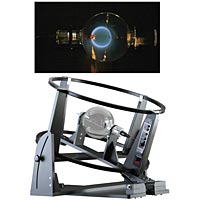
So my very first quantitative demonstration is done with the PASCO e/m device, pictured above.  This is an expensive but worthwhile item.  I put in a capital request a few years ago, and the money came through.  Purchasing one of these would be good use of grant money.  Or, if you can't find the money to buy one of your own, check with the local college's physics department -- most colleges have large numbers of these lying around for use in the freshman lab, and you may be able to borrow one for a week.

Now, this device can do many awesome things.  You can deflect electrons electrically with charged plates; or, you can use a magnetic field to bend electrons in a circle.  The relevant voltages and magnetic fields are either printed right on the device, or are read clearly off of the power supplies.  Certainly this would be a good demonstration in the magnetism section, to show that you can in fact predict the magnetic field given the radius of electrons' circular motion, or to predict the speed of electrons in a circle, or to verify the equation for electrical potential energy, qV.  But at the begninning of the unit, all these concepts are completely foreign.  I do something much, much simpler.

All I tell the class is that I have electrons that have been given a kinetic energy of 4 x 10-17 J.  (Sure, I figured that out using qV... but I say NOTHING about that to the class.)  Then, I tell the class that these electrons experience a magnetic force that acts as a centripetal force, and that is equal to qvB.  I tell them the value of this magnetic field thing labeled as B, which equals 7.8 x 10,-4 T. 

The question:  what is the radius of the electrons' circular motion?

We follow a Newton's Second Law approach, drawing a free body diagram, setting the net force equal to ma, where acceleration is v2/r.  We solve in variables first to get r=mv/qB. We use the definition of kinetic energy (and the looked-up mass of the electron) to calculate the speed of the electrons.  We look up the charge of the electron.  Plugging in, we find that the radius of the circular motion should be in the neighborhood of 6 or 7 cm. 

Then I turn on the device and hit the lights.  We see a dim greenish circle inside the big globe, a circle of diameter that we measure to be... between 12 and 14 cm. 

Follow-up questions that I ask right there:  1. If I increase the magnetic field thingy, what should happen to the circle of electrons?  Well, since B is in the denominator, the radius should get smaller.  (Then I increase the current to the Helmholz coils, increasing the magnetic field, and the circle gets tighter.)  2. If instead I give the electrons more kinetic energy, what should happen to the circle of electrons?  Well, increasing the kinetic energy increases the electrons' speed.  Since v is in the numerator, the circle's radius should get bigger.  (Then I increase the voltage on the electron gun, increasing the electrons' speed, and expanding the circle.)

This demonstration provides a nice "gee, wow" effect, while hammering the point:  once an electricity or magnetism problem can be phrased in terms of forces or energies, then it becomes a mechanics problem -- and we already know how to deal with those.

18 June 2009

Electric Field Lines and how Martin Kirby introduces them


Readers, forgive me, for I have sinned. I have not taught my AP physics B class how to sketch electric field lines.

Now, before you call the official College Board Audit Police, I ask that you hear my reasons. After all, I certainly teach about electric fields in general, what electric fields do to a charge placed in them, and even how parallel plates or point charges can themselves produce electric fields. We even do an extensive variety of exercises in which we determine the magnitude and direction of the electric field produced by a multitude of charges at various positions in space. (See
this post, for an example of fundamentals quiz questions on electrostatics.)

I’ve never introduced the field line representation formally. If I mention field lines at all, it’s because my class has done an old Physics Bowl test question asking about them. I’ll then note that field lines just tell us the direction of the electric field at any point, with the closeness of the field lines indicating the strength of the field. I say this in sort of “by the way” manner, making it clear that electric field lines are not something that the class needs to know about. And until this year, AP exams have not been particularly concerned about field lines and their meaning.
[1]

Why don’t I pay more attention to field lines, which any physics professor would consider part of the cannon of introductory physics knowledge? Because first-year physics students have enough trouble merely understanding what an electric field is without trying to represent the electric field in an abstract way. On the rare occasions I have introduced field lines, students have tend to memorize pictures without grasping the reason for them. Second year students seem to get the idea, but newbies? Not a chance.

I may change my approach next year, if I can find a little bit of extra time. Martin Kirby, a fellow long time AP physics reader, described to me his approach to electric field lines. After his class has mastered
[2] the idea of what an electric field is and what it means, he guides his students through a discussion of the electric field near a point charge. “Describe [in words] the electric field near this positive charge,” he says. His students indicate that the field points away from the charge, and is stronger near the charge than far away. Then comes the magic question:

“Okay, if you were asked to DRAW the electric field, how would you do it?” Then he lets the students chew on that for a while. They come up with all sorts of clever ideas, often involving the degree of shading, or colors, or annotations with numbers. After about 20 minutes of discussion and student attempts, he shows them an idea. “What if we drew lines,” he asks. “We point the lines in the direction of the field. The more lines we draw, and the closer those lines are to each other, the stronger the electric field.” Finally, Mr. Kirby shows the class how his idea works for a single point charge, as well as for two point charges.

Because the students have spent so much time trying to make their own representation of an electric field, they tend to latch on to Mr. Kirby’s simpler option.


[1] Take a look at 2009 AP physics B problem 2(a), which asks students to sketch electric field lines near two positive point charges.
[2] For the highest available value of “mastered,” of course

22 February 2009

Electric fields and potentials of point charges

The electric FIELD produced by a point charge is E = kQ/d2. The electric POTENTIAL produced by a point charge is V = kQ/d.

Electric field is a vector. This means that the equation E = kQ/d2 gives just the magnitude of the electric field, and therefore the sign if the charge producing the field should NOT be plugged into the equation. The direction of the field is away from a positive charge, and toward a negative charge.

Electric potential is a scalar. This means that the sign of the charge producing the potential SHOULD be plugged into the equation V = kQ/d. Positive charges produce positive potentials; negative charges produce negative potentials.

When more than one charge produces an electric field, the net field is found by vector addition. When more than one charge produces an electric potential, the net potential is found by algebraic addition and subtraction.

I can’t begin to tell you how frustrating it is to go over the above paragraphs 30 times in 15 different ways with 80 different examples… and then to see someone tell me that the electric field due to a couple of charges is “(2-Q)/d.” Aargh!!!

Such is the nature of electricity, though. I have to remind myself time and again how abstract the idea of a “field” is to begin with, let alone potential, the concept of “charge,” the creation of a field or potential… double Aargh!

The only success I’ve found at the physics B level with these topics is through repetition. There is no choice but to ask students quiz questions 30 times in 15 different ways with 80 different examples. If that doesn’t work, give it a rest for a week… then ask a 31st time.

Below are four questions from a fundamentals quiz which get to the heart of electric fields and potentials due to point charges. Can you answer them correctly? (Post a comment with your answer! If you’re wrong, that’s okay… someone will correct you.)

1. What is the electric potential produced by a -3Q charge a distance of 2a away from the charge?

2. What is the magnitude of the electric field produced by a -3Q charge a distance of 2a away from the
charge?


3. In the diagram to the right, what is the magnitude of the electric field produced by the two charges at point P?


4. In the diagram to the right, what is the vertical component of the electric field produced by the –Q charge at point P?


GCJ

(Photo at the top from alexhulbert.com . )